How to turn meeting notes into a clear action list
· Editorial team newswithjameschicago.com
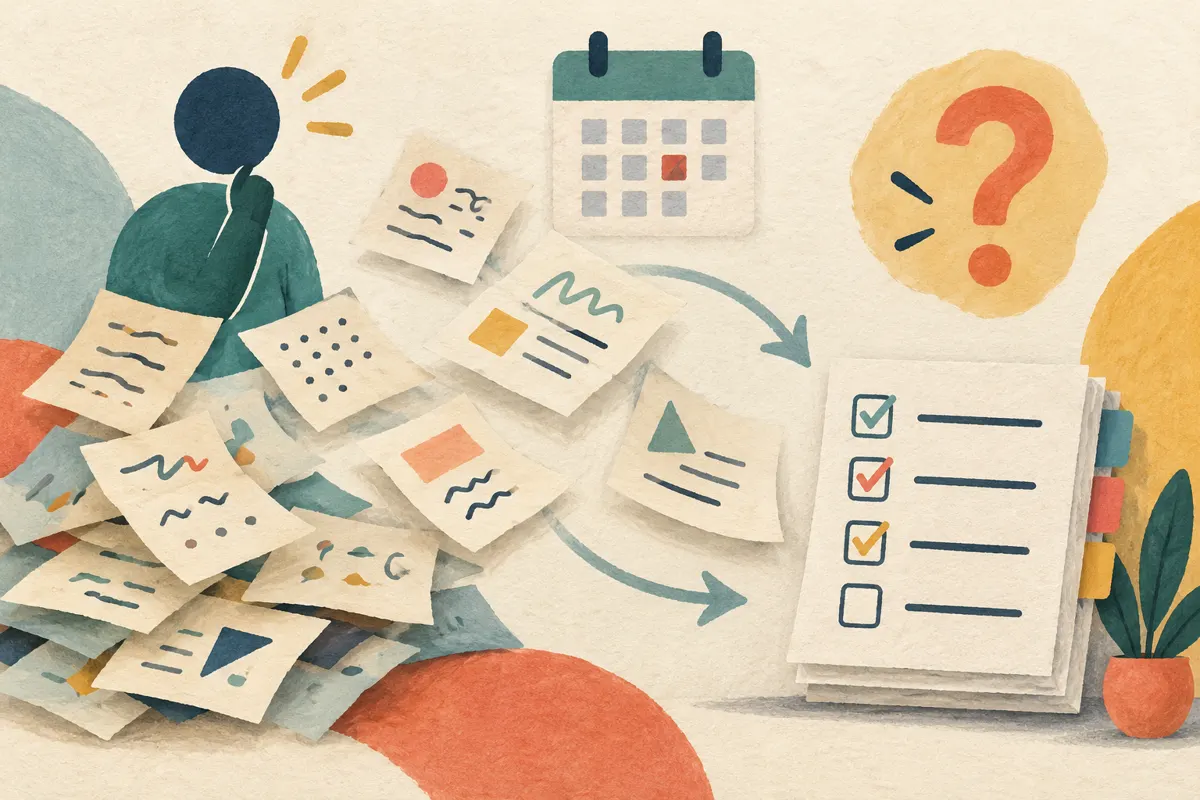
To turn meeting notes into a clear action list, pull out agreed tasks, rewrite each as a specific next step, and record its owner and agreed deadline. Keep decisions and unresolved questions separate so readers can see what was settled, what needs doing, and what still needs an answer.
Separate agreements from the conversation
Read through your notes once before creating tasks. A suggestion, a concern, and a commitment can appear in the same paragraph, but they mean different things. Preserve enough context to explain an agreement without carrying every comment into the action list.
- Decision: an outcome the group agreed on, such as choosing which version of a document to use.
- Action: work someone agreed to do, such as sending that version to the team.
- Discussion or idea: useful context that has not become a commitment.
- Open question: something that still needs information, clarification, or approval.
Watch for tentative wording such as “could,” “maybe,” and “we should consider.” Do not silently convert it into an assigned task. If the notes do not show whether the group agreed, mark the item for confirmation.
Rewrite each task as a concrete next step
An action item should tell its reader what to do without requiring them to reconstruct the meeting. Start with a verb, name the thing being worked on, and describe the output or recipient when that matters. Keep one main action in each entry.
- Instead of “Budget follow-up,” write “Send the revised budget spreadsheet to the project lead for review.”
- Instead of “Look into feedback,” write “Summarize the feedback on the draft and list the changes requested.”
- Instead of “Fix onboarding,” write “Draft a checklist covering the missing onboarding steps identified in the meeting.”
If a note describes a broad goal, identify the next agreed step rather than inventing a full project plan. For a task with several handoffs, separate the steps when different people own them. Add a short completion condition, such as “complete when the revised file is shared,” if the endpoint would otherwise be unclear.
Confirm owners and agreed deadlines
Record who is responsible for each task and when it is due. A person mentioned during the discussion is not necessarily the person who accepted the work. If several people will contribute, confirm who will coordinate the task and report its progress.
- Check whether the notes identify an agreed owner. If they do not, write “Owner to confirm.”
- Record the agreed due date. Replace relative wording such as “next Friday” with an exact date after checking the intended date.
- If no deadline was agreed, write “Deadline to confirm.” Keep any suggested date clearly labeled as a proposal.
- Note dependencies, such as needing an approved draft before sending the final document.
Avoid filling gaps simply to make the list look complete. A visible missing owner or date gives the team a specific point to resolve; an assumed commitment can misrepresent what happened.
Give unresolved questions their own place
Keep unanswered questions beside the action list in a separate group. State what needs to be answered and which task, if any, depends on it. This keeps uncertainty visible without presenting an undecided issue as an approved action.
For example, “Which draft should go to the client?” is an open question. “Ask the project lead which draft is approved” becomes an action only if that follow-up was agreed. If nobody accepted it, label the proposed follow-up and request an owner.
Share the list and keep it usable
Clean up and share the notes promptly after the meeting. Put the action list where participants already look for work, and retain a link or reference to the meeting notes for context. If you use an automated summary, check it against the notes before treating its suggested tasks as commitments.
- Can each owner understand the task without another explanation?
- Are owners and deadlines confirmed or visibly marked as unresolved?
- Are decisions, proposals, and open questions clearly distinguished?
- Have repeated tasks been combined without losing important details?
- Does each completed item show the result or where to find it?
Ask participants to flag corrections, especially to ownership, dates, and scope. At the next check-in, review unfinished actions and blockers. Update the existing entries as work progresses so the team has one usable record of what remains.